Recruiter and operations generalist who builds tools with AI.
Hi! I'm Thena. I studied mechanical engineering at Berkeley (B.S. and M.S.), and until October 2026 I was the recruiter and supply chain manager at JLS Trading Co., a small, fully remote company that sells on Amazon. I've also taught over 1,500 online English lessons along the way. I'm based in Cambodia, so my evenings line up with US mornings.

Explore
English (native) · Spanish (B2) · Khmer (A2)Recruiting →
High-volume hiring, an internship program built and run solo, and a site that answers "is this company a scam?"
Operations →
About $200K a year in purchasing, daily Amazon restocking, and the tools I built for both.
AI Projects →
Five tools built with AI coding agents, and how I check what the AI produces.
Tutoring →
Students aged 3 to 65, with a 5-star rating on Preply.
Replen Copilot
A daily restocking assistant for an Amazon seller. It recommends a quantity for every product and explains its math in plain English. It matched 95% of the team's real decisions over a month.
Read the full story →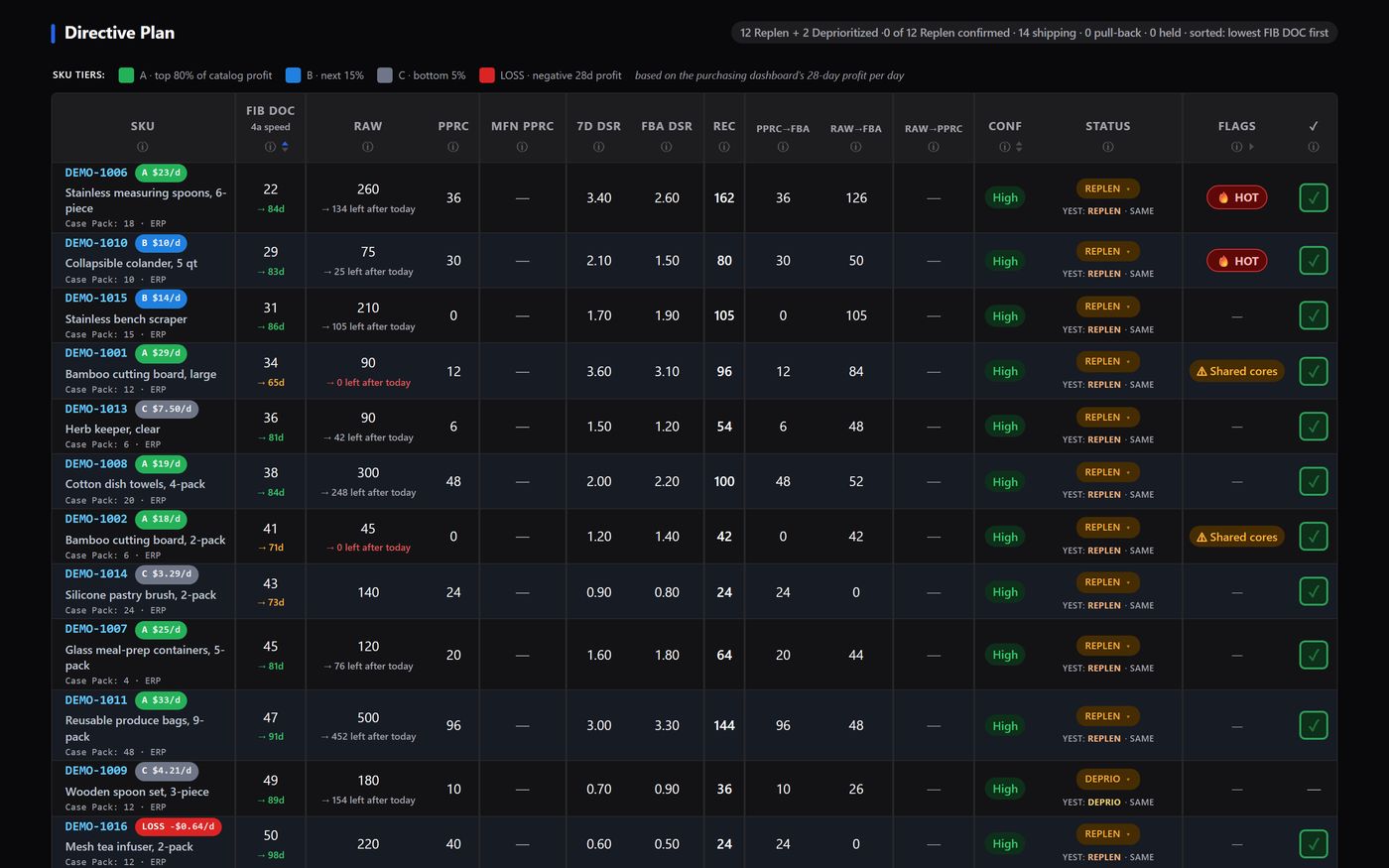
Let's talk.
Open to remote recruiting, operations and AI roles.
Recruiting
Two years of high-volume hiring for a fully remote company, and before that, most of the hiring for a Berkeley campus program that grew from 20 to 100 staff.
JLS Trading Co. · June 2024 to October 2026
- Screened 1,000+ applications a month at peak and ran 25 to 50 interviews a month, using written questionnaires and hiring tests.
- Posted roles on LinkedIn and Indeed and ran the pipeline in JazzHR, from hiring tests and scheduling through onboarding.
- Worked with hiring managers to choose 10+ new hires across design, engineering, videography, copywriting and social media, and raised it early when a candidate's pay expectations ran above budget.
- Built and ran a new internship program in Indonesia solo, recruiting through university outreach. 5 interns joined, and 2 stayed on in regular roles.
- Worked on the hiring tests: helped edit them, started a question bank and scoring rubric, and studied why some candidates passed the first test but failed later stages.
- Designed two opt-in programs for the remote team: a 7-week fitness challenge and a 2-week personal time challenge.
UC Berkeley Night Security · 2020 to 2023
- Grew the dorm night security program from 20 to 100 staff during the post-COVID reopening, and hired and onboarded most of the 80+ new staff myself.
- Designed the program's hiring criteria, training, scheduling and protocols, and led teams of about 20 staff per night.
Recruiting project
isjlsreal.com
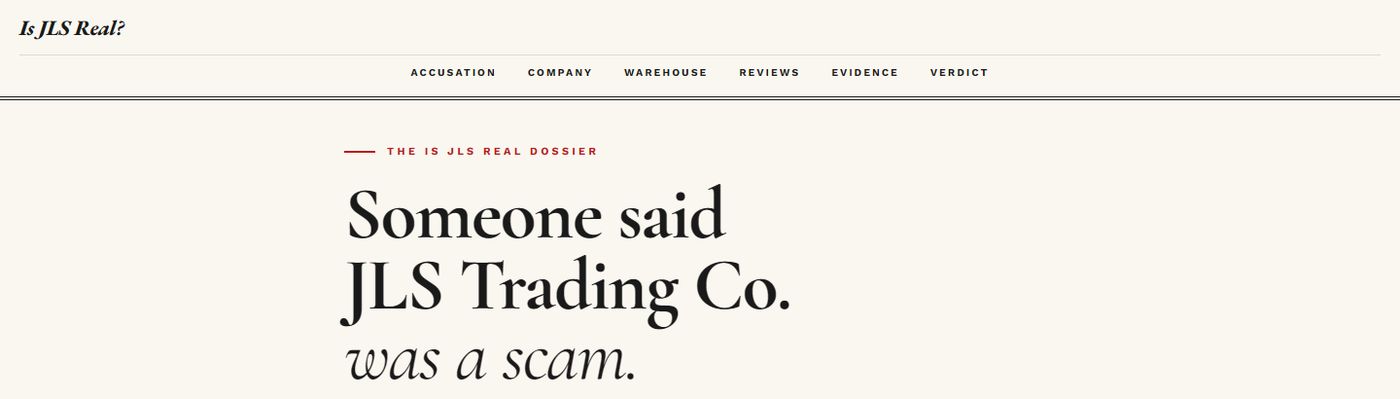
An employer-branding site that answers "is this company a scam?"
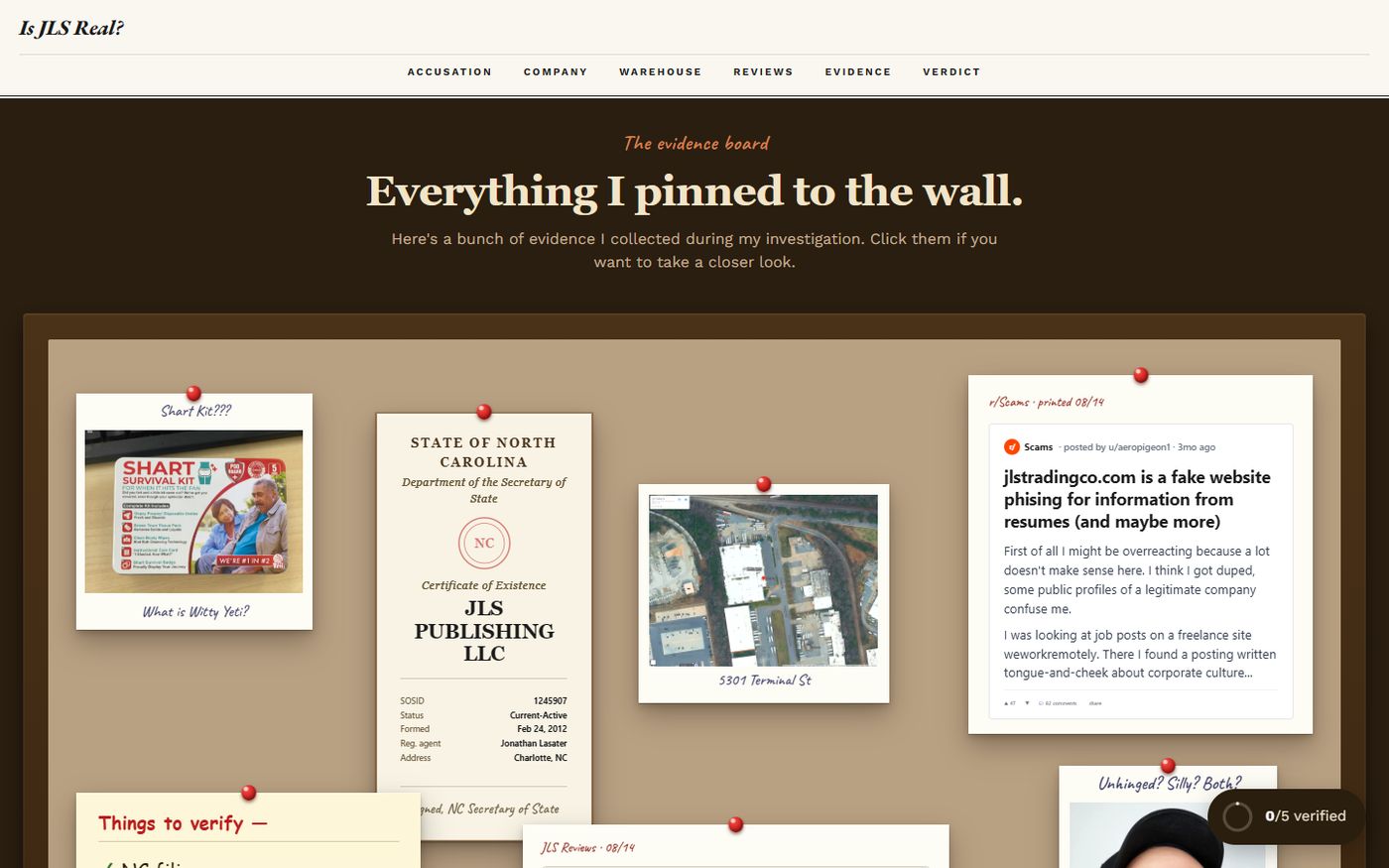
A lot of people applying to JLS found an old Reddit post calling the company a phishing scam, which, honestly, I get: it's a small, fully remote company. Instead of ignoring it, I planned and built a whole site that investigates the claim with humor and actual proof: video episodes, a corkboard of real evidence like the state business filing, and a "verify it yourself" checklist. One of my coworkers narrates it and stars in the videos.
What I'm proud of
- I wrote a full spec first, covering who it was for, the voice, and every section.
- Before choosing the tools, I built a throwaway version just to test speed. It scored 100 on all four of Google's mobile page scores, so I knew it would hold up on phones.
- A script flags any copy that drifts out of the narrator's voice, and the build fails if the speed or accessibility scores drop.
- A weekly automated report shows how the site is doing in Google search, and the company's careers page links to it.
Live: isjlsreal.com
Operations
At JLS I ran all of US purchasing and daily Amazon restocking, on top of recruiting, and built tools to make both easier.
JLS Trading Co. · Supply chain
- Ran all US purchasing: about $200K a year across 30 to 40 suppliers, with purchase orders for 50 to 75 products.
- Owned daily Amazon restocking across a few hundred products: how much to ship, when to ship it, and when to bundle or unbundle.
- Handled supplier problems, including defects, delays and short shipments, and vetted new suppliers in China.
- Compared six China-direct vendors for shipping mailers on landed cost and tested their samples. The vendor I recommended was projected to cut costs 29 to 43% compared with Uline.
- Wrote a 10-phase training outline so new hires could learn to run daily restocking on their own.
Operations projects
Replen Copilot
A daily restocking assistant for an Amazon seller
Every morning at JLS, someone had to decide how much of each product to send to Amazon's warehouses, and that meant juggling three spreadsheets and a lot of gut feel. I wanted the reasoning to live somewhere other than people's heads, so I wrote the rules out as specs, tested them against past stockouts, and directed AI coding agents to build an app around them. It pulls all three sheets into one screen, recommends a quantity for every product, and explains its math in plain English so the reviewer can check it or override it.
What I'm proud of
- Before writing any code, I tested different ways to estimate demand after a product sells out, using 868 product-weeks of real stockouts, and went with what the data supported.
- Every recommendation comes with a plain-English reason, and there's a Logic tab that lists every threshold and where it came from. The rule I kept coming back to was "the app recommends, the reviewer decides."
- Some of our products are bundles that share parts, which the old spreadsheet treated as completely separate. The app adds those up and warns you when today's plan would pull more of a shared part than is actually on the shelf.
- When I compared it against a month of the team's own decisions, it matched 95% of the product statuses it could reproduce.
- By the numbers: 390 commits, 114 merged pull requests, and about 875 automated tests.
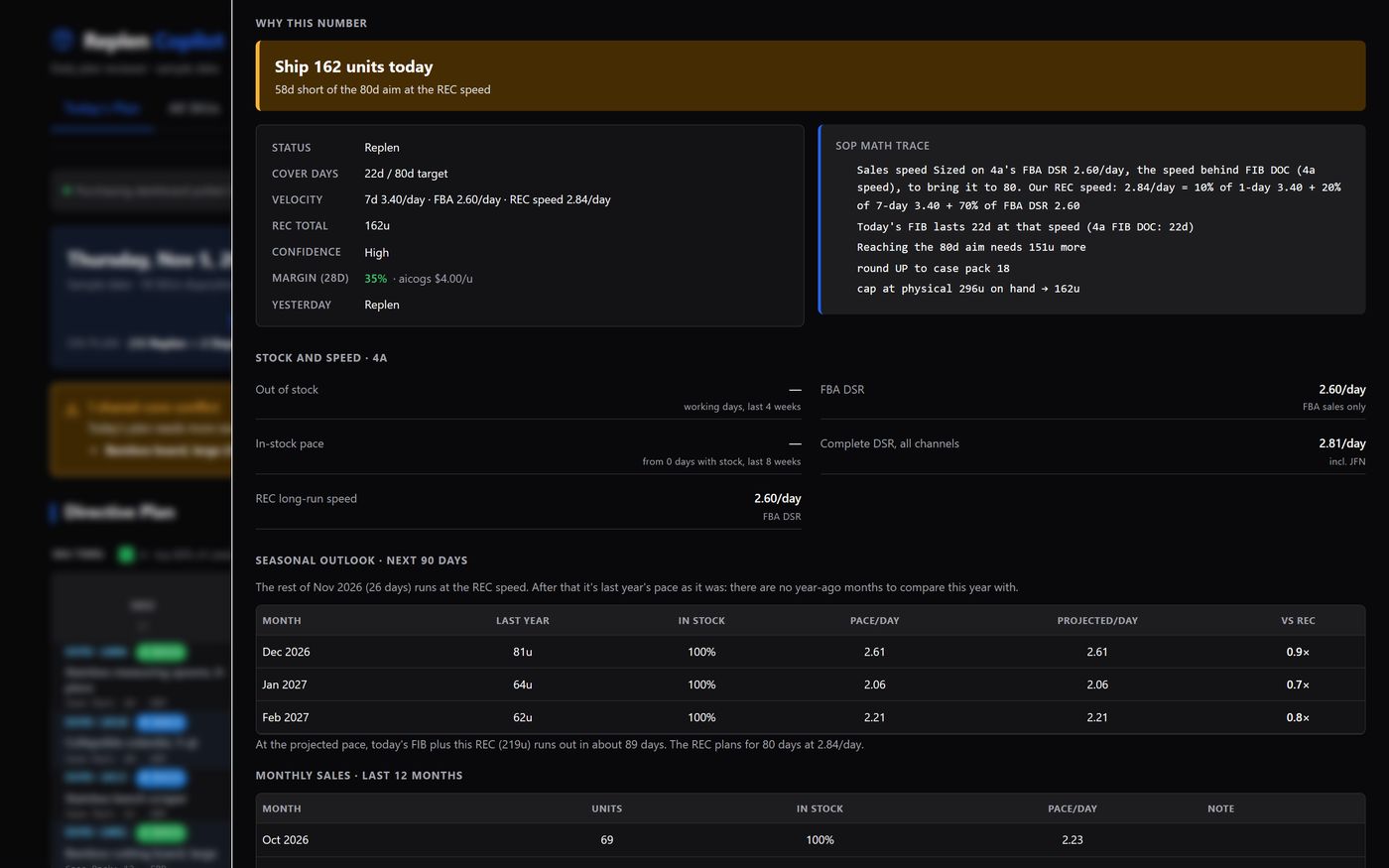
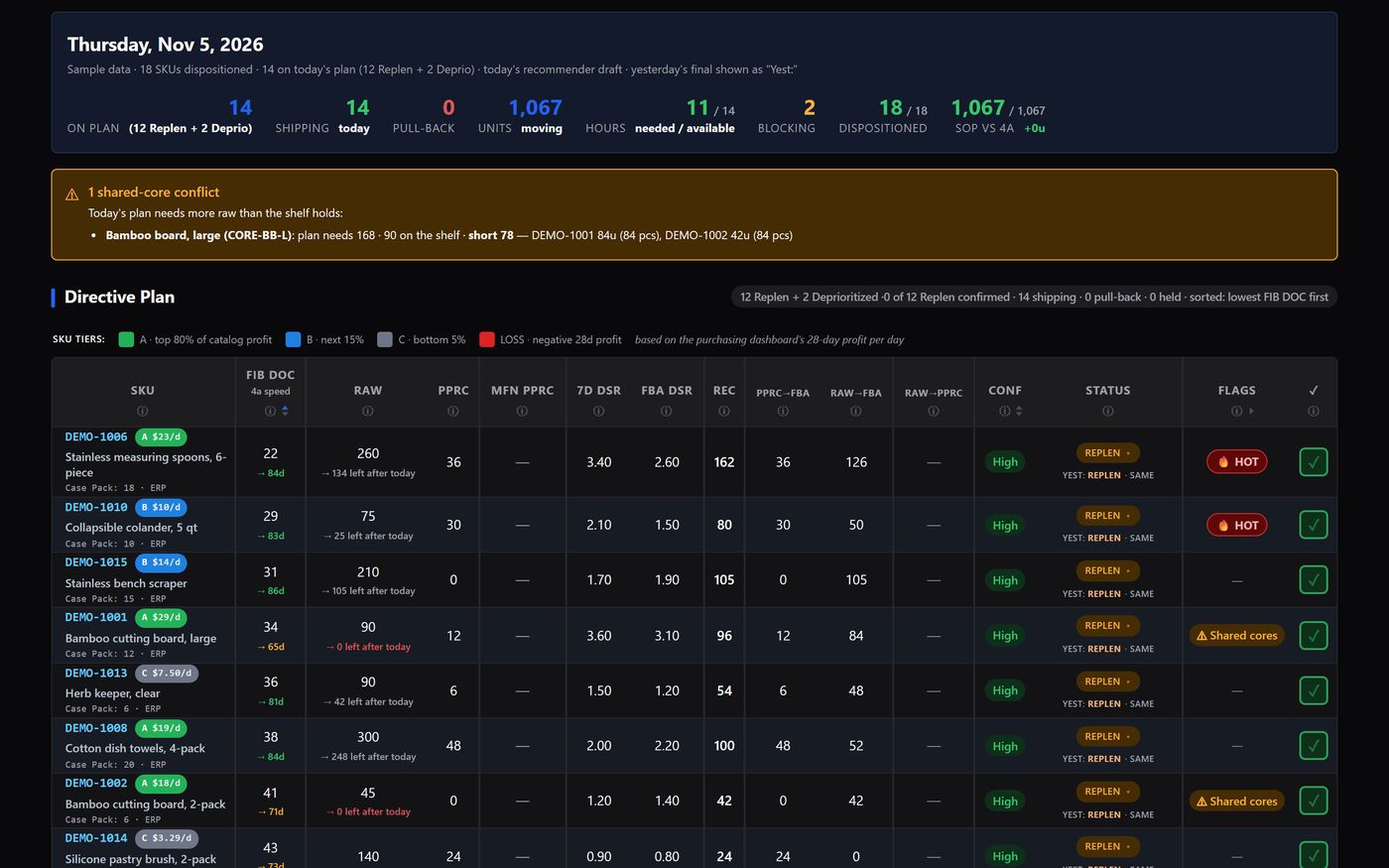
Status: I handed the prototype off to engineering to take to production. Since it's an internal tool, the screenshots use made-up products and numbers.
JLS Sourcing Tools
From a messy product idea to a screened vendor list, with AI that shows its reasoning
Finding a new supplier at JLS took about a dozen manual steps spread across a bunch of different tools, so I mapped the whole process out as a 12-stage pipeline and built the first part of it as three connected tools. The Spec Sheet Generator turns rough notes into a proper spec sheet, the vendor pool builder searches the web for factories that could make it, and the Sourcing Hub ties it all together so a person can screen the list before any quote requests go out.
What I'm proud of
- You can paste in messy call notes and drop in PDFs or photos, and Claude fills in the spec for you. Anything it isn't sure about gets flagged in amber so a person confirms it instead of trusting a guess.
- One run makes two documents: an internal spec with our sales history and pricing, and a vendor-facing request for quotes that leaves all of that out, so we never hand over our negotiating position by accident.
- For the vendor list, Claude plans the searches and then reviews every result, drops the retailers and other non-suppliers, and writes down why for each one. I didn't want to just trust a model, so I ran two Claude models on the same 210 results first. Where they disagreed (23 rows), the bigger model was right about 17 times, so it does the reviewing.
- The AI never gets to quietly throw anything away. If its review fails, every row stays in and gets flagged so a person can look at it.
- When a supplier's email was missing, the tool goes and looks for it on their own website. On one real product, that took us from 16 vendors with an email to 37 out of 68, and each search costs about 10 to 15 cents to run.
- About 300 commits across the three tools, and 464 automated tests on the Spec Sheet Generator alone.
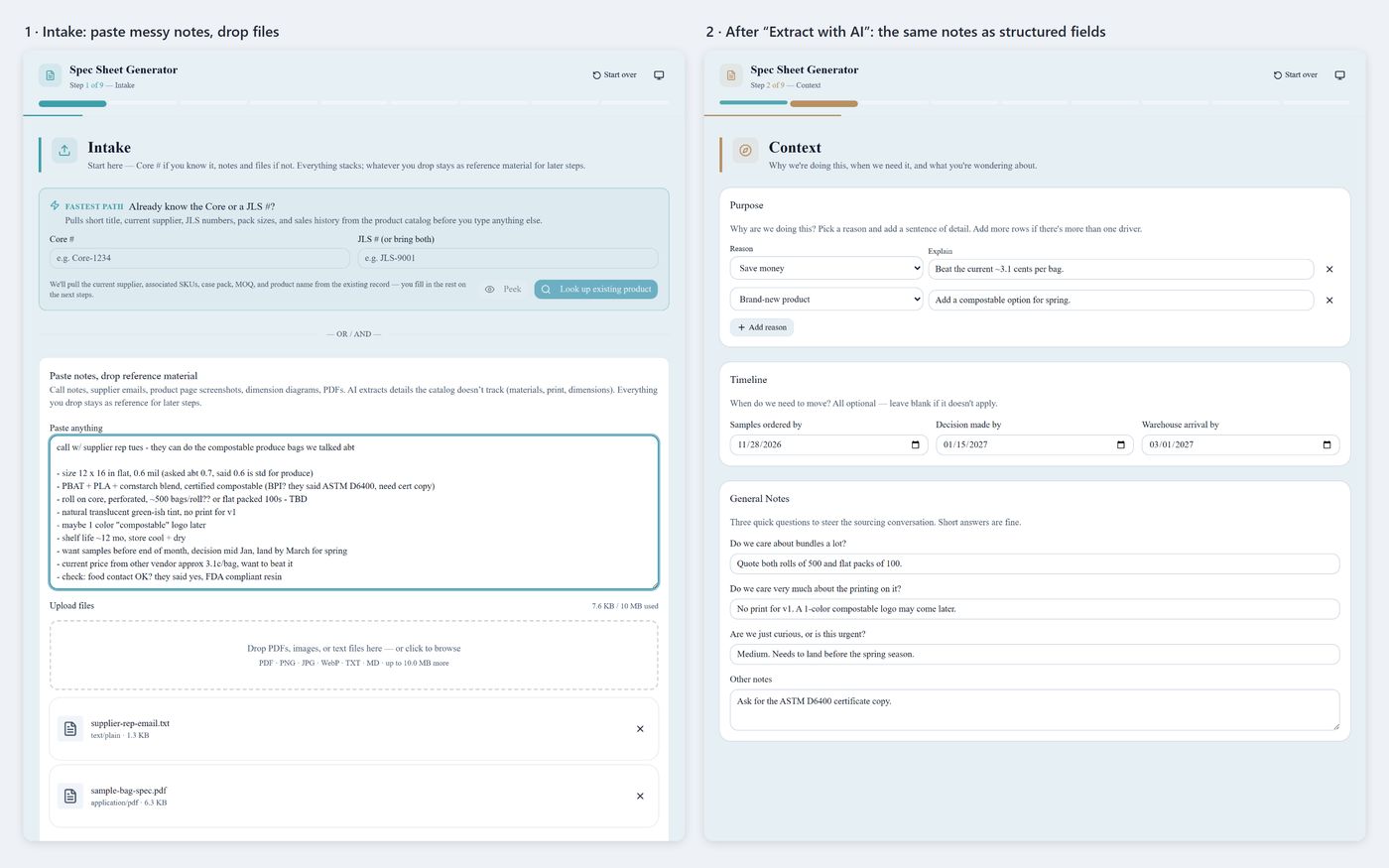
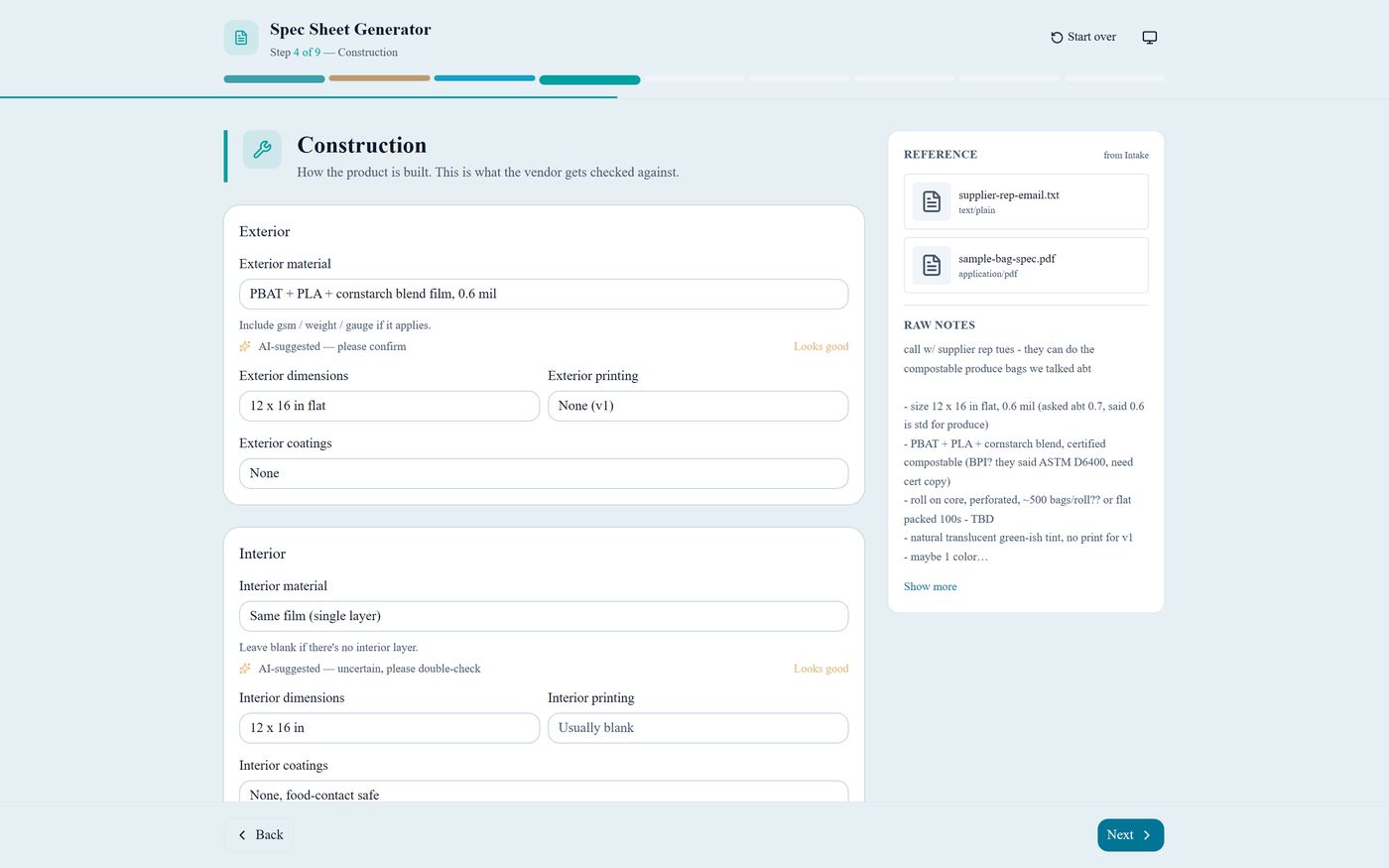
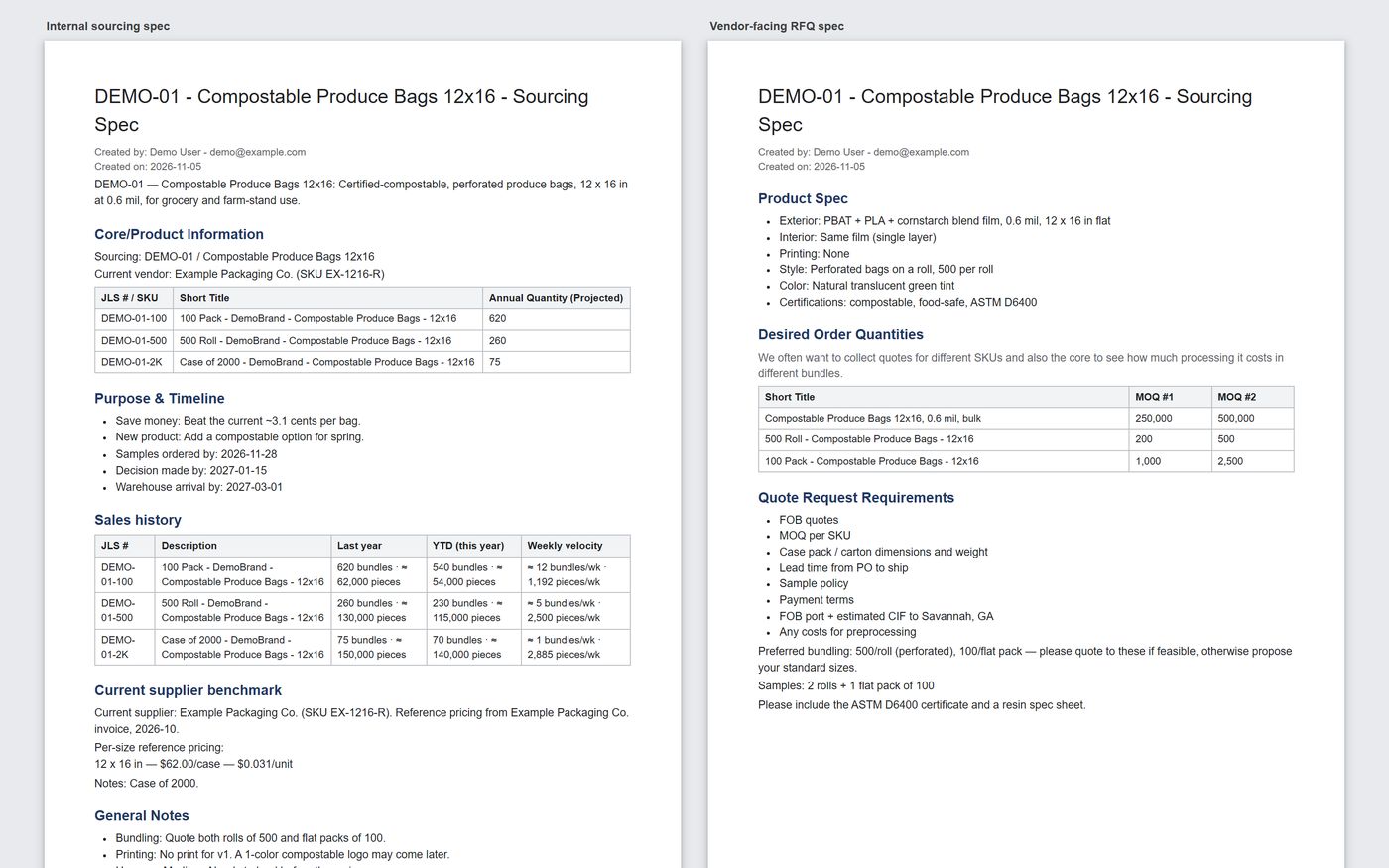
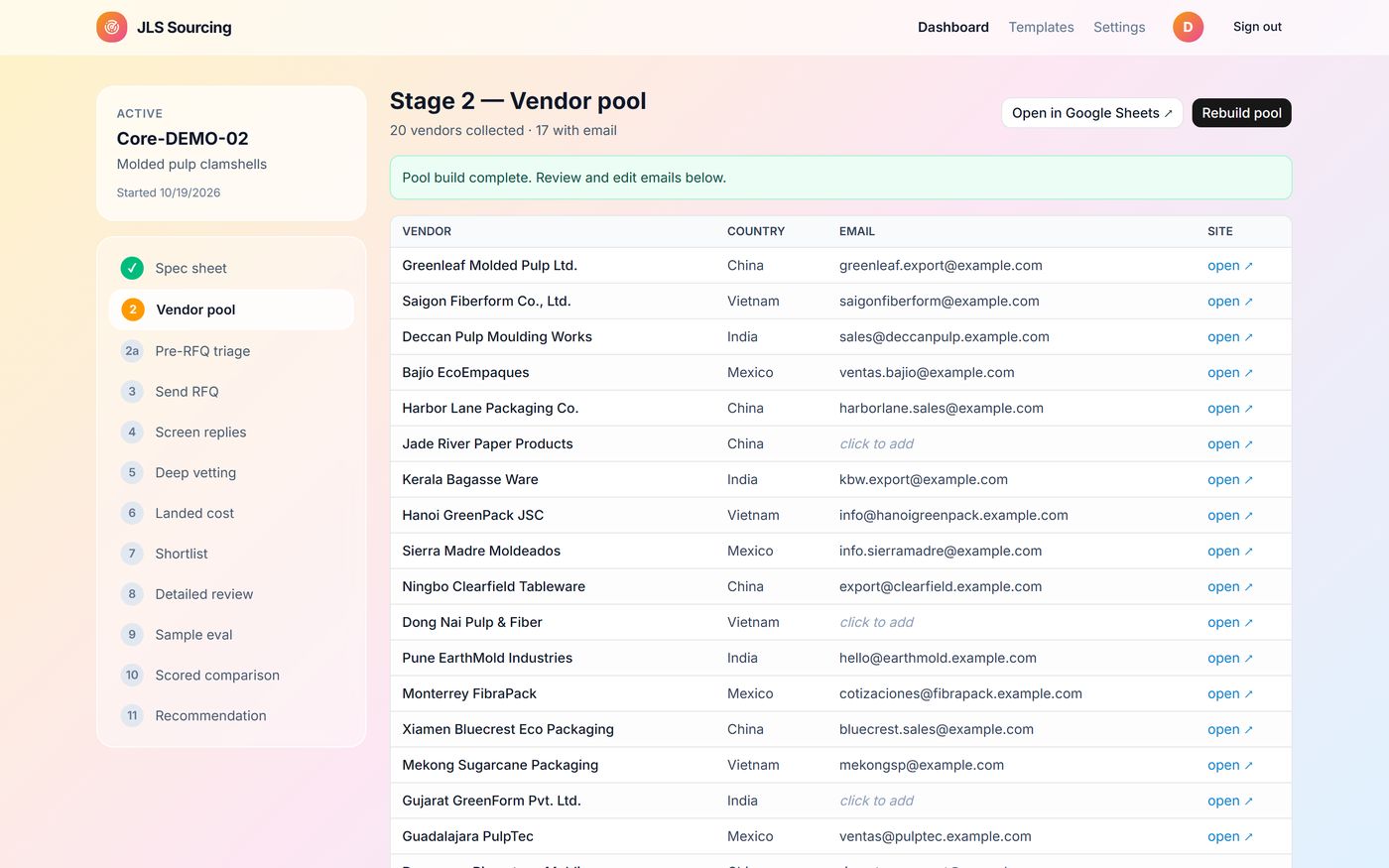
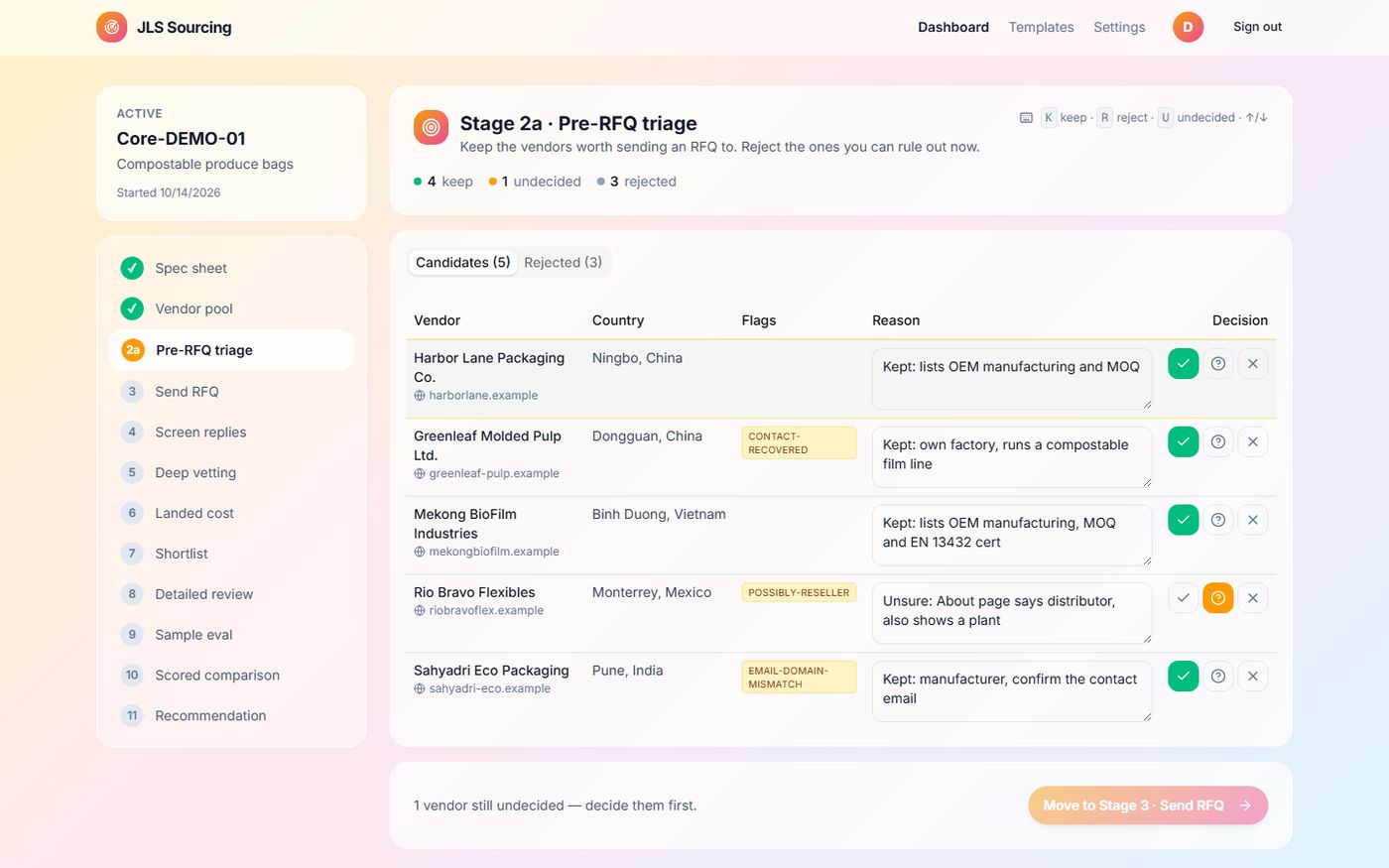
Status: The first 3 of the 12 stages are live as internal tools, and the rest are designed. The screenshots use a made-up product and made-up suppliers.
AI Projects
Over the past year I got really into building tools with AI. Most of them started as a problem I was tired of solving by hand, so I wrote down exactly how it should work, built it with AI coding agents, and then checked it against real data before I let anyone rely on it.
Three of the five live on the tab for the work they were built for:
Personal projects
AI nutrition planner
A meal-planning app I designed and built on my own
This is the one I built entirely on my own, outside of work. It works out your daily calorie and macro targets, matches recipe ingredients to USDA nutrition data, and has Claude fill the empty slots in your week. As your weight changes, it adjusts your targets based on your real trend instead of a formula's guess.
What I'm proud of
- Every AI call has guardrails: a monthly cap per user, a check on the shape of every answer, limits on how far targets can move at once, and a rules-based fallback if the AI is down.
- The calorie math uses the standard Mifflin-St Jeor formula with conservative activity levels, and I cited the sources right in the code.
- I built an AI meal-suggestion feature and then took it back out, because it wasn't adding much beyond plain math and it cost money every time someone used it. I wrote down why, so future me wouldn't add it back.
- At one point I noticed four of the AI checks had been quietly running the fallback for weeks. I traced it to a missing setting, fixed it, and added tests so it can't sneak past again.
- 361 commits and about 960 automated tests.
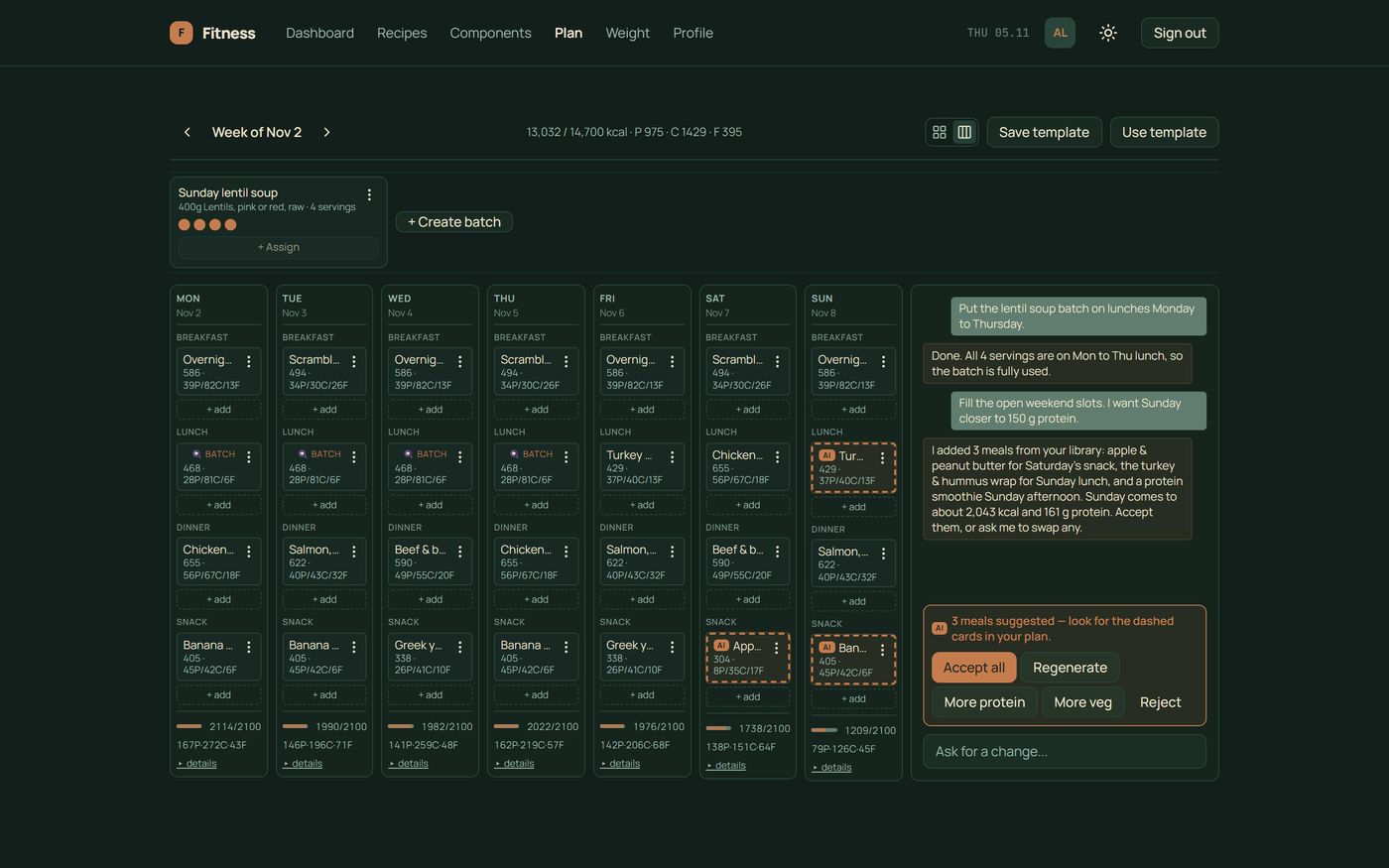
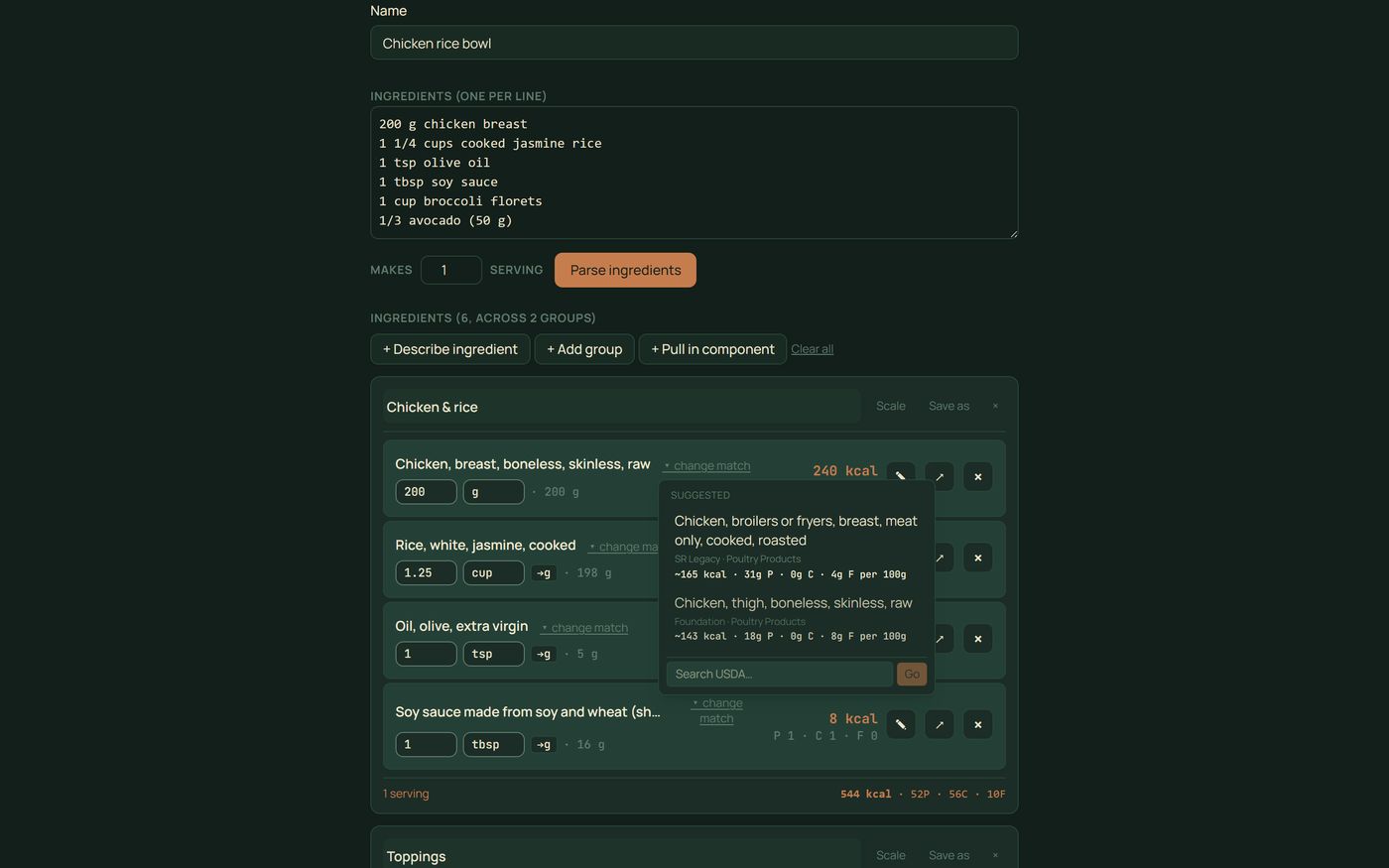
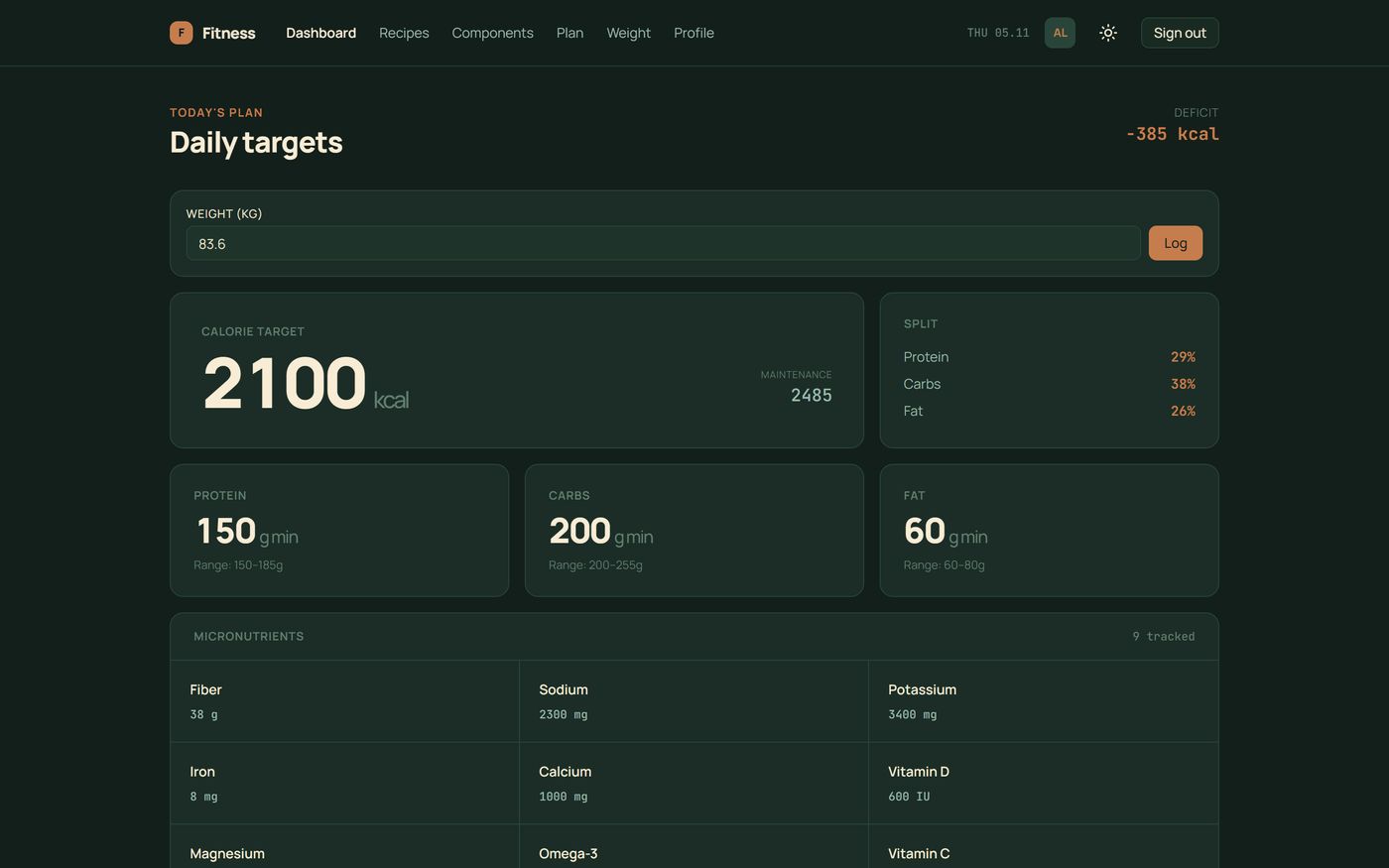
Try it: open the demo. One click signs you into a shared demo account with a full week of meals already planned, no sign-up needed. It resets every night, so feel free to poke around!
Speaking Khmer
A spoken-Khmer course written with two Cambodian teachers
This one means a lot to me. I'm working with two Cambodian teachers on a course for English speakers who want to actually speak Khmer, and we've drafted three books, 71 lessons in all. AI writes the first drafts, the teachers review every chapter at three checkpoints, and anything cultural is their call, not the AI's (or mine).
What I'm proud of
- It's a real curriculum: 3 books, 21 chapters and 71 lessons, all following the same Learn, Practice, Perform pattern.
- The writing runs through a 28-step process with teacher review built in, plus a running log of Khmer usage decisions, so something we decide once stays consistent across every book.
- I built a recording studio in the browser so the teachers can record, trim and re-record every word and phrase. They've recorded 362 clips so far, and every one is leveled to the same volume.
- Readers can tap each syllable of a Khmer word and hear it on its own, which helps a lot with a script that doesn't put spaces between words.
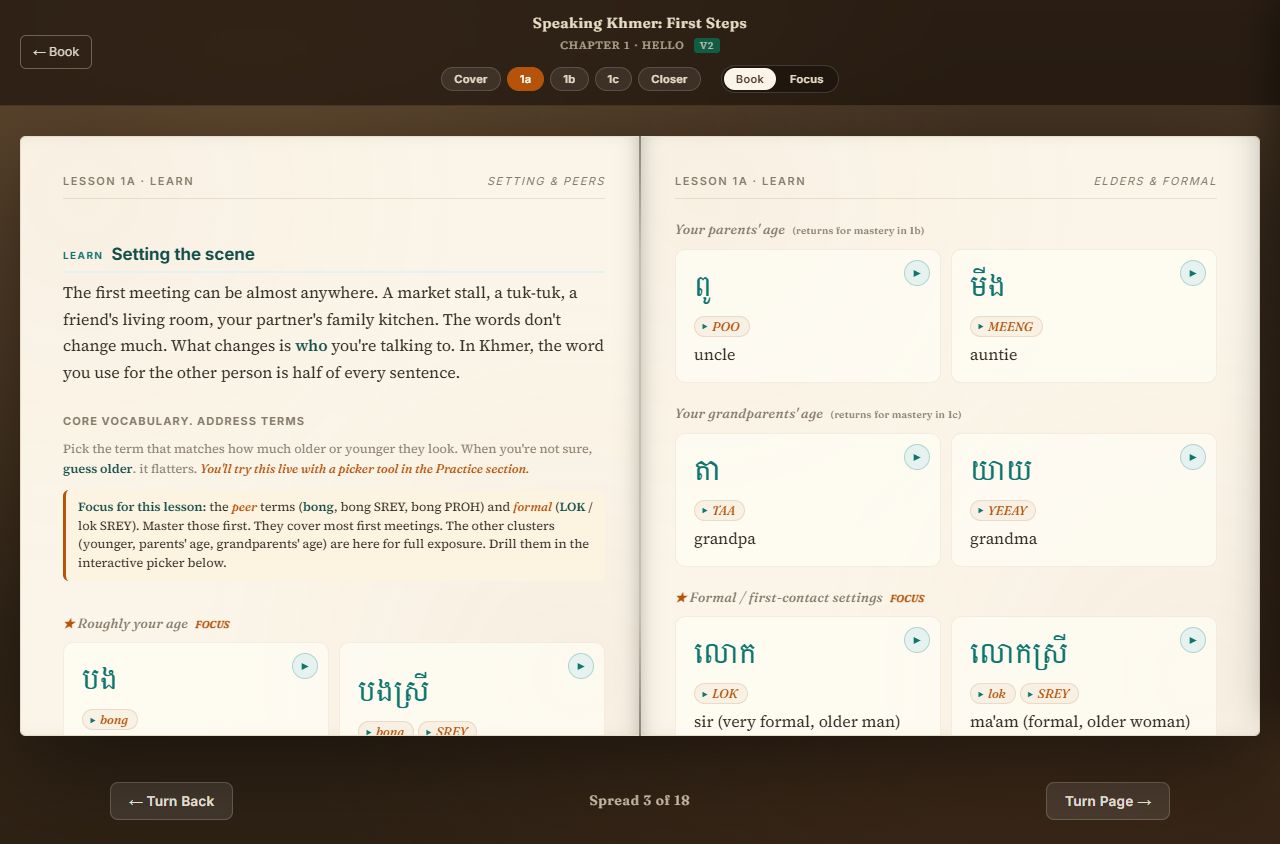
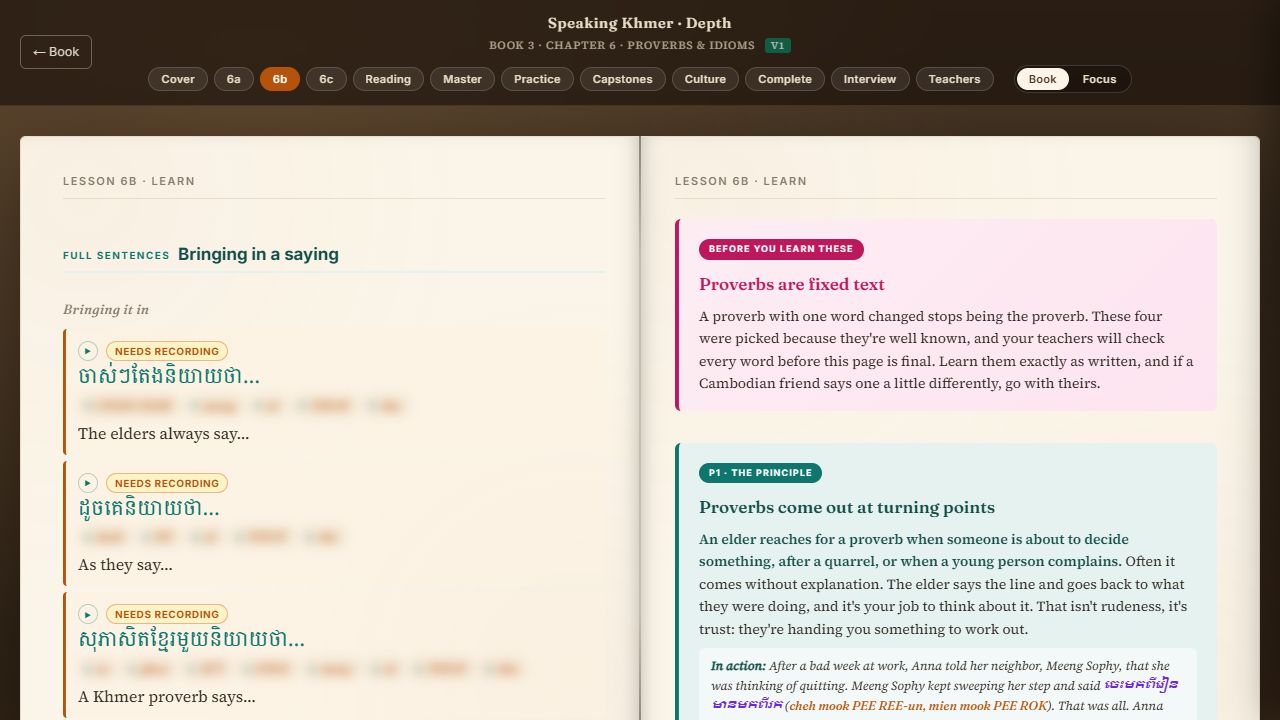
Status: The teachers are recording Book 1 now, and a companion phone app is in progress.
Tutoring
I've taught English online part-time since January 2024, on Preply and with my own private students.
What parents say on Preply
Thena is great! She is my son's English tutor. She is incredibly friendly and professional. She has great patience with young English learners. She is always on time and responds to messages fast. My son's English speaking has improved so much, thanks to her teaching. I really appreciate it and highly recommend her lessons!
Thena is an excellent tutor.. My son was comfortable with her guidance in AP Lang & Composition. He was so confident after her initial guidance itself. Would do SAT Prep with her if time permits for her without any hesitation.
What I teach
- Custom lessons for each student, like B2-level grammar (narrative tenses, reported speech, linking words), each paired with speaking practice.
- High school essay writing, step by step: unpacking the prompt, finding an angle backed by evidence, and turning a weak thesis into a strong one.
- Study skills for younger students, like focus and homework strategies.
- Students from age 3 to 65, from young kids to adults.
Other teaching and training
- Graduate Student Instructor at UC Berkeley (2022 to 2023), leading weekly hands-on labs for 20+ students in design, manufacturing and SolidWorks.
- Ranked in the top 10% of instructors on official course evaluations in a 116-student course.
- Hired and trained most of the 80+ new staff for Berkeley's night security program, and built its training program.
- 168-hour Level 5 TEFL Certificate from The TEFL Org, 2026.
Contact
If anything here sounds like a fit, I'd love to talk!
Open to
All remote. I'm a US citizen based in Cambodia (UTC+7), so my evenings line up with US mornings. I've worked fully remote with a team spread across several countries, so I'm used to time zone gaps.